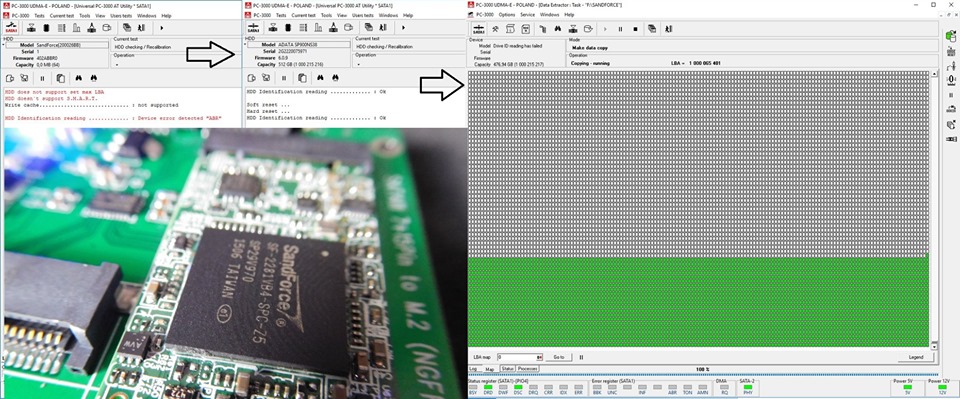
Solid State Drives are hard drives that instead of platters, like in HDD, are NAND or DRAM memorys. Thanks to that those drives are much faster and not that fragile. But as it goes with flash memory – less durable. There are more than hundred of producers at the moment. Data recovery from SSD is a much more complex process.
SSD data recovery – technological mode
In this mode we can recover data in case of damaged firmware or translator corruption. If a drive is not physicaly damaged and in electronicaly working condition but not recognized in any computer or visible as SATAFIRM – we can use this mode to recover data in most cases. If a drive is visible with 0MB, each sector is read with just 00 tecnological mode is also a good way to recover data.
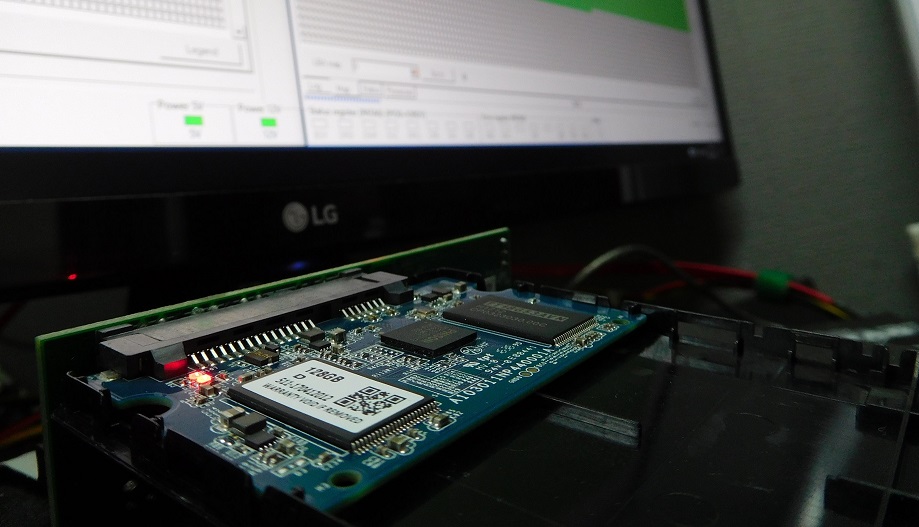
LIST OF SUPPORTED CONTROLLERS:
Silicon Motion family (SM2246LT, SM2246XT, SM2246EN, SM2256K)
Phison family (PS3105, PS3108, PS3109, PS3110)
Toshiba (Phison) Family (TC58NC1000/PS3110)
Marwell VanGogh \ VanGogh 2 family (88SS9174, 88SS9187, 88SS9189, 88SS9190, 88SS1074)
SAMSUNG family
Indilinx Barefoot family (IDX100/IDX110)
OCZ (Barefoot 3) family (IDX500Mxx)
JMicron\Toshiba family (JMF616 and TC58NCF616GDT)
Intel Postville family (PC29AS21AA0)
LAMD family (LM87800)
Also we recover data from SANDFORCE based drives if they are not stuck in BSY state.